The New England state recently passed a law that effectively removes all limits on abortion.
Pro-life advocates in Massachusetts are moving to halt the implementation of a recently passed law that effectively removed all limits on abortion in the state, aiming to both put the issue on the ballot before voters and potentially suspend the law as well.
Massachusetts became the latest state in the U.S. to remove all restrictions on abortion when Democratic Gov. Maura Healey signed the law on Aug. 10. It allows women to obtain abortions at any point in pregnancy for any reason.
Oklahoma City Archbishop Paul Coakley, the president of the U.S. Conference of Catholic Bishops (USCCB), called the policy "shocking" and "horrendous" shortly after the law was signed. He described the measure as "an affront against the dignity of life."
A pro-life coalition, meanwhile, is leading an effort to roll back the law, aiming to place the policy before voters on a statewide ballot and potentially suspend the law prior to that vote.
The Repeal 188 initiative is seeking up to 50,000 signatures to potentially roll back the law. The process — known as a "veto referendum" — requires advocates to collect signatures equal to at least 1.5% of votes cast in the most recent gubernatorial election in order to put the repeal question on the 2028 statewide ballot.
If petitioners are able to collect signatures equal to 2% of the total number of those votes, meanwhile, they can suspend the law prior to the election. The effort says it needs 37,289 signatures to qualify for the ballot and 49,716 to suspend the law.
Steve Petrarca, a Massachusetts resident and a member of his parish's pro-life committee, told EWTN News that "many" parishioners at his church were unaware of the effort. Petrarca himself is helping to gather signatures.
He said advocates may aim to collect closer to 100,000 signatures in order to ensure they meet the threshold to suspend the law. A distribution requirement in Massachusetts means no more than 25% of signatures on a petition can come from any one single county in the state.
The abortion measure drew rebuke from the state's Catholic bishops, who described it as "a radical measure which is gravely immoral." The advocacy group CatholicVote, meanwhile, called for Healey — who identifies as Catholic — to be excommunicated.
"Healey is a Catholic in a state of grave sin. She has publicly and now legislatively cooperated in the destruction of innocent human life," CatholicVote President Kelsey Reinhardt said.
In a video released amid the campaign, Massachusetts Citizens for Life President Myrna Flynn said signatories must be registered voters in the state and under state law can only sign petitions that are local to them.
"If we receive 50,000 signatures by October 23, Massachusetts voters — not activist politicians — will get to decide this very important issue in 2028," she said.
One hundred years after the start of the Catholic resistance that led to the Cristero War, the Church in Mexico proposes re-examining this period "objectively."
"It seems very important to fully understand this history, a history that has been erased from Mexico's history books," stated Bishop Héctor Mario Pérez Villarreal, secretary general of the Mexican Bishops' Conference, as he encouraged participation in the colloquium "One Hundred Years Since the Start of the Cristero Resistance," taking place this week in Mexico City.
At a press conference ahead of the Oct. 14-16 event, Pérez Villarreal, who is also an auxiliary bishop of the Archdiocese of Mexico, noted that in commemorating the centennial of the religious conflict experienced in the country, known as the Cristiada or Cristero War, "rather than celebrating the tragic nature of this event, the violence, or the war, we commemorate the witness of faith of so many Mexicans."
"Mexicans, primarily the laity, went to the defense of their faith, self-defense, and their ability and freedom to express what they believed," he noted.
The prelate recalled that Mexican Catholics in the first half of the 20th century faced "a situation in which the law was clearly violating a fundamental right: the right to freedom of faith and religious expression."
Amid rising tensions between the Church and the Mexican state, tensions that dated back to the second half of the 19th century, the armed uprising known as the Cristiada broke out in 1926, with Catholics from various parts of the country taking up arms against civil authorities.
The conflict arose in the context of the so-called "Calles Law," which went into effect on July 31 of that year and severely restricted public worship and the religious life of Catholics.
Pérez Villarreal emphasized that with the colloquium, in which experts from Mexico and other countries are participating, "we are not seeking to vindicate any form of violence; rather, we want to delve deeper into the truth."
Events like this, he noted, "help us view reality objectively rather than through the lens of ideology," enabling us "to live in a freer Mexico."
He further maintained that the conflict "was not an attack on the clergy; it was an attack on the religious freedom of an entire people," and emphasized that this fundamental right is not one the state can decide to grant or not.
"Universal rights are not granted by the state; they are guaranteed by it," he noted.
The event, organized by the Mexican Bishops' Conference (CEM by its Spanish acronym) in conjunction with the Pontifical University of Mexico (UPM by its Spanish acronym) and the Mexican Society of Ecclesiastical History, includes lectures at the Plaza Mariana of the Basilica of Our Lady of Guadalupe and at the UPM auditorium in Mexico City.
Father Juan Carlos Casas García, director of the UPM's Department of Ecclesiastical History and the CEM's Department of History and Art, emphasized that the Catholic resistance "went beyond an armed uprising."
He explained that there was "peaceful resistance by Catholics who found their rights violated by legislation that openly infringed upon religious freedom and the activities of the Catholic Church in our country."
The aim of the colloquium, he noted, is "to complete and broaden the understanding of this chapter" of Mexican history, a history marked by "contrasts, with both light and shadows."
The priest noted that, "while acknowledging that this is a painful period in our history, it is also a historical episode filled with testimonies of faith and fidelity that we cannot forget."
This story was first published by EWTN News Español, the Spanish-language sister service of EWTN News. It has been translated and adapted by EWTN News English.
"It is the most common cause of lung cancer in smokers and nonsmokers," said Jeff McGovern, a pulmonologist, about Pope Leo's diagnosis.
Representatives of the American Lung Association and the Catholic Medical Association (CMA) discussed possible underlying causes of Pope Leo XIV's lung cancer and potential treatment options.
Dr. Jeff McGovern, a pulmonologist, and Dr. Juanita Mora, spokesperson for the American Lung Association, appeared on "EWTN News Nightly" on Oct. 14 to discuss the Holy Father's health following surgery. The Oct. 13 surgery involved the removal of the lower lobe of his right lung and confirmed a diagnosis of lung adenocarcinoma.
"It is the most common cause of lung cancer in smokers and nonsmokers," said McGovern, a CMA member. He said "treatments can be varying depending on the size," and can involve chemotherapy, immunotherapy, or radiation in addition to the surgical removal of the lower part of the lung.
The type of ongoing treatment the pope receives will depend on the results of a pathology test, which will reveal the stage of the cancer and whether it is contained or has spread to other areas, McGovern said.
The pathology test "usually takes a couple of days," or sometimes even longer, he said, but noted that because the patient is the Holy Father, "I would expect the pathology would be available a lot sooner than usual."
"In the best of all possible worlds, if it is contained, then going forward, as far as treatment, it's a CT scan every six months and then after about two or three years, a year thereafter. And that would be the treatment, and that would be the ideal setting for the Holy Father," he said.
Mora, a Catholic who is also from Chicago, Pope Leo's hometown, said if the Holy Father's pathology report reveals that the cancer has not spread, the survival rate is 80% to 90%. A spread would determine "whether he will get chemotherapy, radiotherapy or whether he will need actual immunotherapy that's geared exactly to the biomarkers of the tumor that turn positive."
Mora said the Holy Father is "someone who is active," playing tennis and staying in shape. "He's a 71-year-old healthy, strong man. This is what Pope Leo has going for him," she said.
"We know that he's going to be at higher risk for some viral respiratory infections," she said. "So, it is important for him to get his Covid-19 vaccine, his flu vaccine, and his RSV vaccine for those that are eligible."
In terms of travel, Mora said his doctors may determine he needs anticoagulation, or blood thinners, "so that he's at less risk of developing any clots, especially with the long flight that he has, [as well as] all the respiratory virus infections."
By the numbers: Impact of lung cancer
"One person is diagnosed with lung cancer every 2.5 minutes," Mora said. "In the United States, we lose 238,000 people a year due to lung cancer. And it's the No. 1 cause of mortality from cancer in both men and women in the United States."
In addition to smoking, Mora highlighted several other causes of lung cancer, including radon gas, "a colorless, odorless gas that can seep in through cracks in our ground, in our home, or through cracks in walls," ozone pollution, and particle contamination.
By bringing His Presence to the streets, grace overflows.
St. Patrick's Cathedral erupted in laughter. The oil of annointing dripped down from now Bishop Joseph Espillat's hairless head onto his smiling face as Cardinal Timothy Dolan joyfully handied a towel to him to clear his eyes.
At that time, Espillat would become the youngest bishop in the United States. And he brought with him a passion for evangelization and the Blessed Sacrament the likes of which would join an ever-growing movement, the Eucharistic Revival, that was in its infancy.
About a year later, after photographing a priestly ordination at St. Patrick's Cathedral, a photographer friend of mine nudged me and asked if I was going to the Eucharistic procession in Times Square. To which I glanced him and asked, "What procession?"
I was sitting on 51st Street with a sandwich and a cold cup of coffee, sorting photos and writing down a few thoughts. The procession wasn't until late afternoon, and I was already pretty tired. I wasn't planning to go. So I left it in God's hands, which, once again, proved to be the best idea.
Hours later, I found myself in Father Duffy Square, surrounded by thousands of people praying before the Blessed Sacrament. And there at the center of it all was Bishop Espaillat, his energy and joy unmistakable. The atmosphere was electric.
In a place the world knows for its lights and spectacle, people had gathered to adore Christ. I'd nearly missed it because I was "tired." Now I was standing in the middle of Times Square, trying to take in something utterly breathtaking.
And now, another invitation to follow Him into the streets.
On Oct. 13, 2026, the Napa Institute returned to St. Patrick's Cathedral for its annual Eucharistic procession.
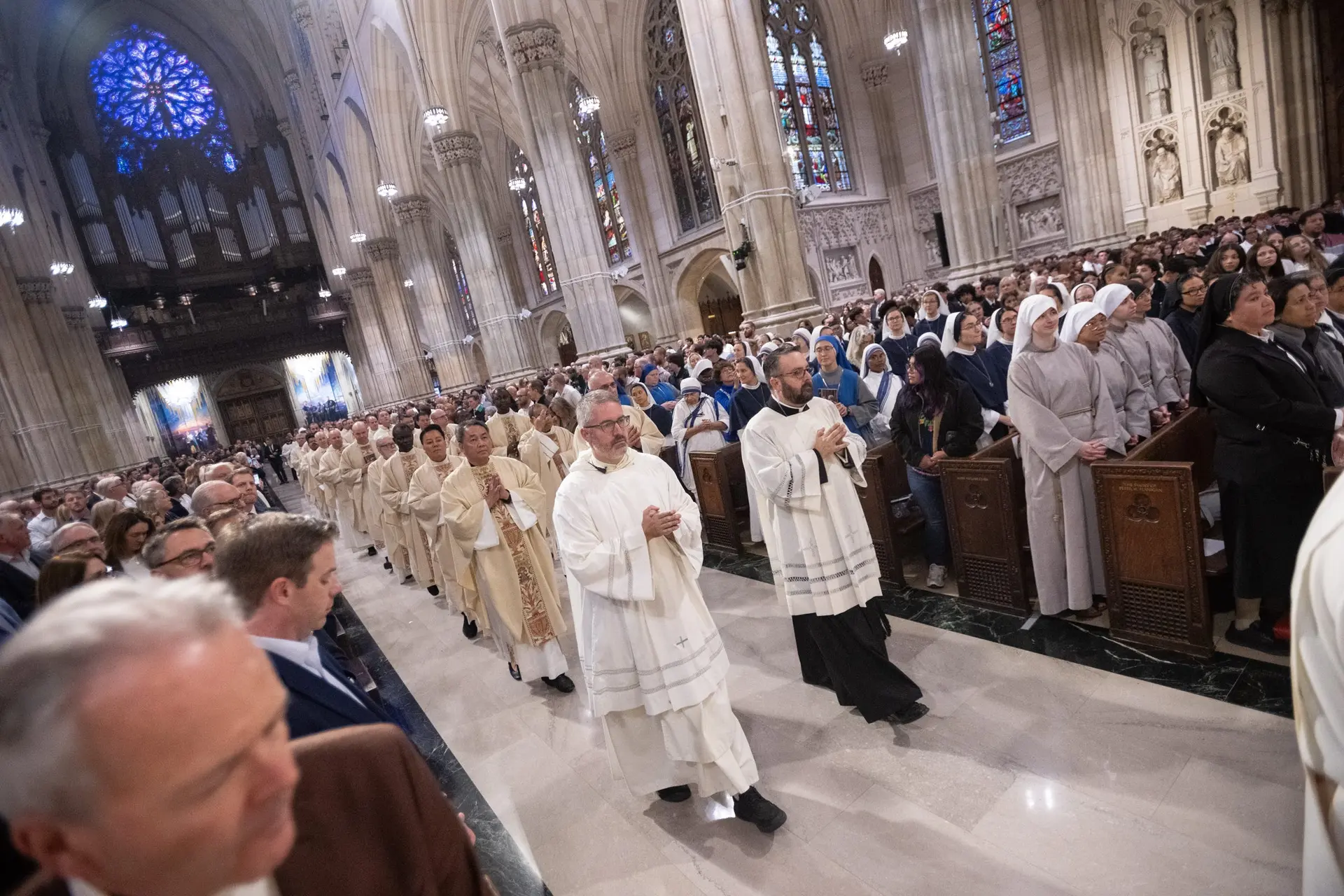
The priests make their way through a packed cathedral. So many lives, gathered around one altar. | Credit: Jeffrey Bruno
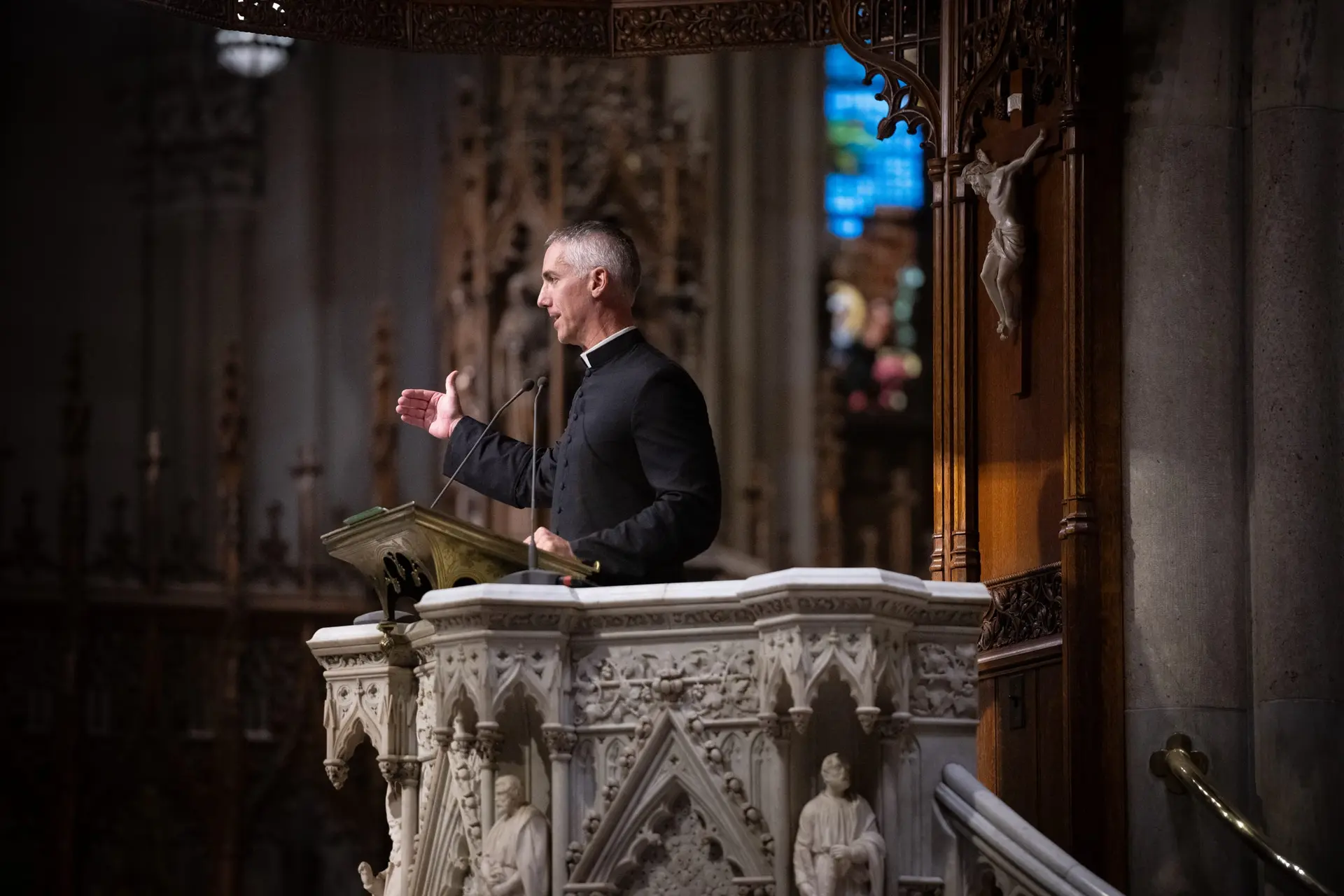
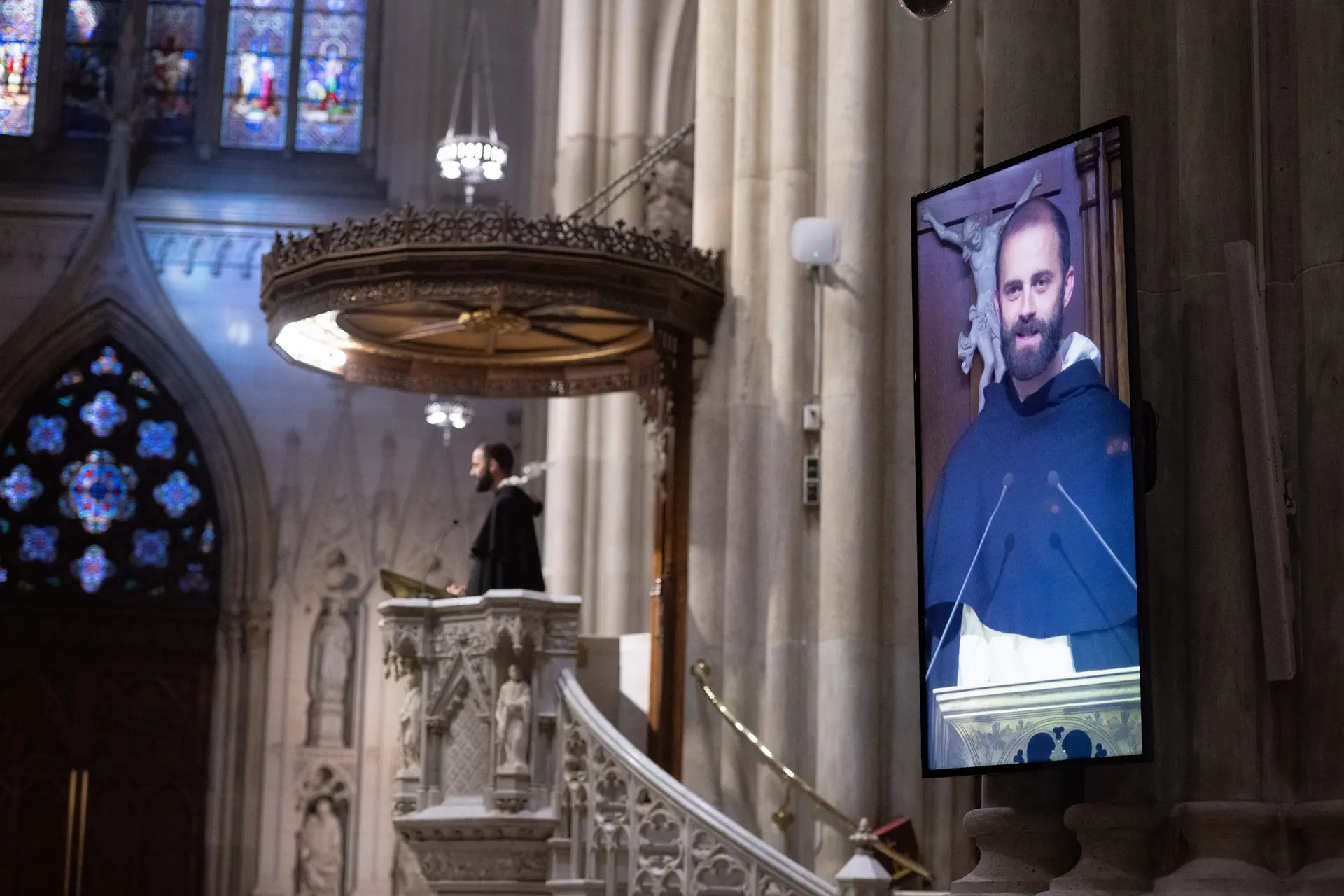
And that same bishop, whose anointing filled the cathedral with laughter, and whose joy I encountered in Father Duffy Square, celebrated the 4 p.m. Mass and preached the homily. He was joined by Dominican Father Gregory Pine and Father John Burns who led Eucharistic meditations before Mass. After Mass, the Eucharistic procession spilled from the cathedral onto the crowded city streets to bring the Presence of Christ and the witness of faith of countless thousands made through Midtown.
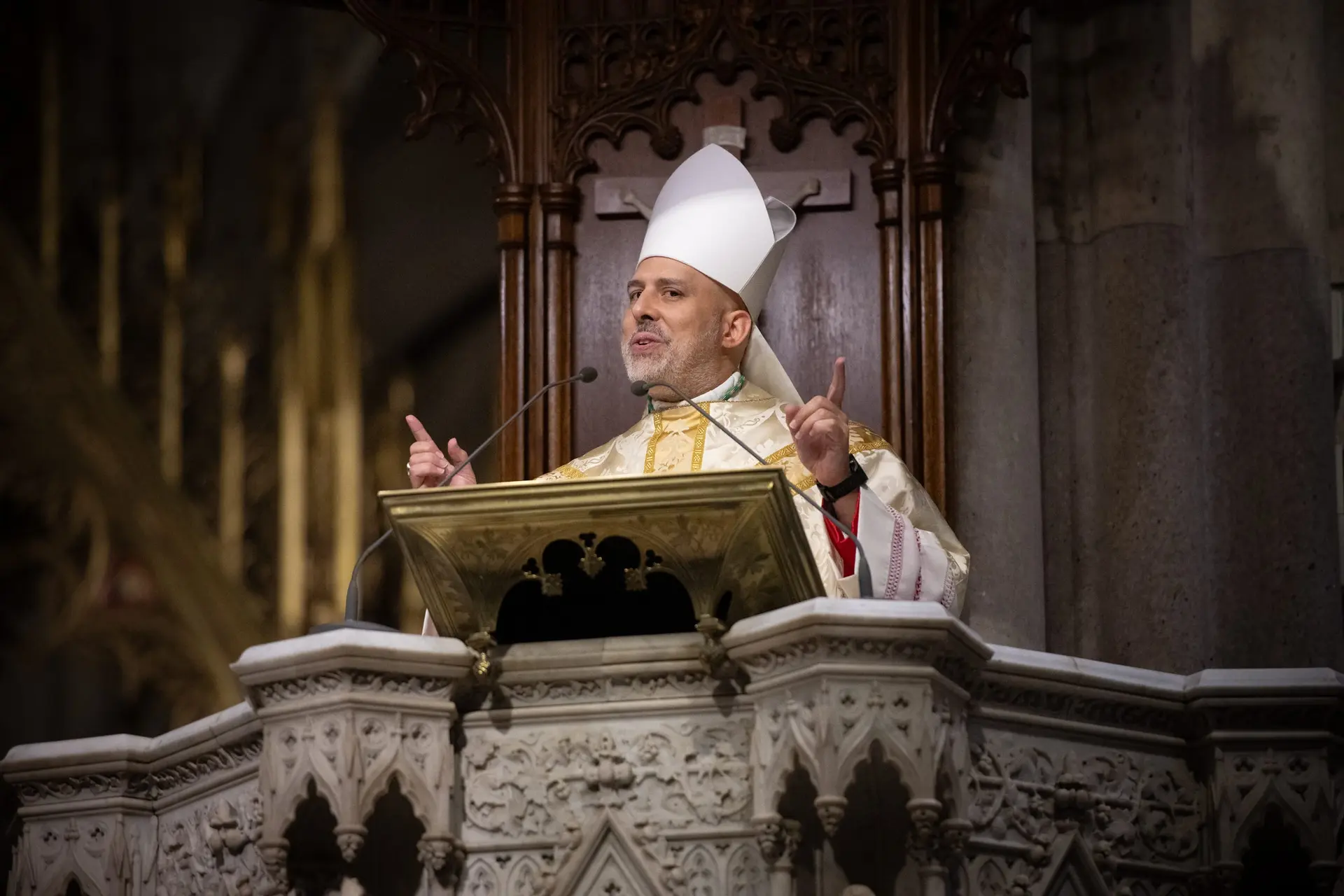
Bishop Joseph Espaillat preaches. Encountering Christ asks something of us…including a willingness to see the people we too easily pass by. | Credit: Jeffrey BrunoFather John Burns offers a reflection beneath the crucifix. Before we follow Christ into the streets, we make room to hear Him. | Credit: Jeffey BrunoFrom the pulpit to a screen beside the pews to the live stream, the afternoon's reflection reaches across the cathedral and world. An invitation to draw closer, wherever we find ourselves sitting. | Credit: Jeffrey Bruno
Napa's New York procession began in 2021. Its invitation simple: accompany Christ in the Blessed Sacrament through the city. It takes a faith nourished at the altar into the streets, where anyone passing by might encounter it.
Since then it's been the inspiration of countless Eucharistic Processions around the world. Even the National Eucharistic Revival that launched in June 2022 carried that same desire to renew Catholics' relationship with Christ in the Eucharist.
In his homily, Espaillat preached about the people we too easily pass by. His homily was grounded in the day's readings: Jesus at the Pharisee's table and the cup polished outside while something remained wrong within. The remedy was almsgiving, a heart learning to give. He spoke of mercy made concrete, turning us toward the needs of another.
Near the end, he recalled Archbishop Charles C. Thompson of Indianapolis telling young people that they were a mystery to be encountered. Then he extended that invitation to babies, immigrants, people experiencing homelessness, and inmates on death row.
"Young people are not a problem to be figured out. They are a mystery to be encountered!" he said.
And then came the challenge.
The bishop was asking us to look honestly at our own hearts, and he gave us somewhere to begin. Support a food pantry. Walk with someone who is lonely or anxious. Sit down with someone whose views differ from our own and have a Christ-like conversation. Give quietly, without announcing it on social media.
"Be kind. Give out of love, not out of obligation."
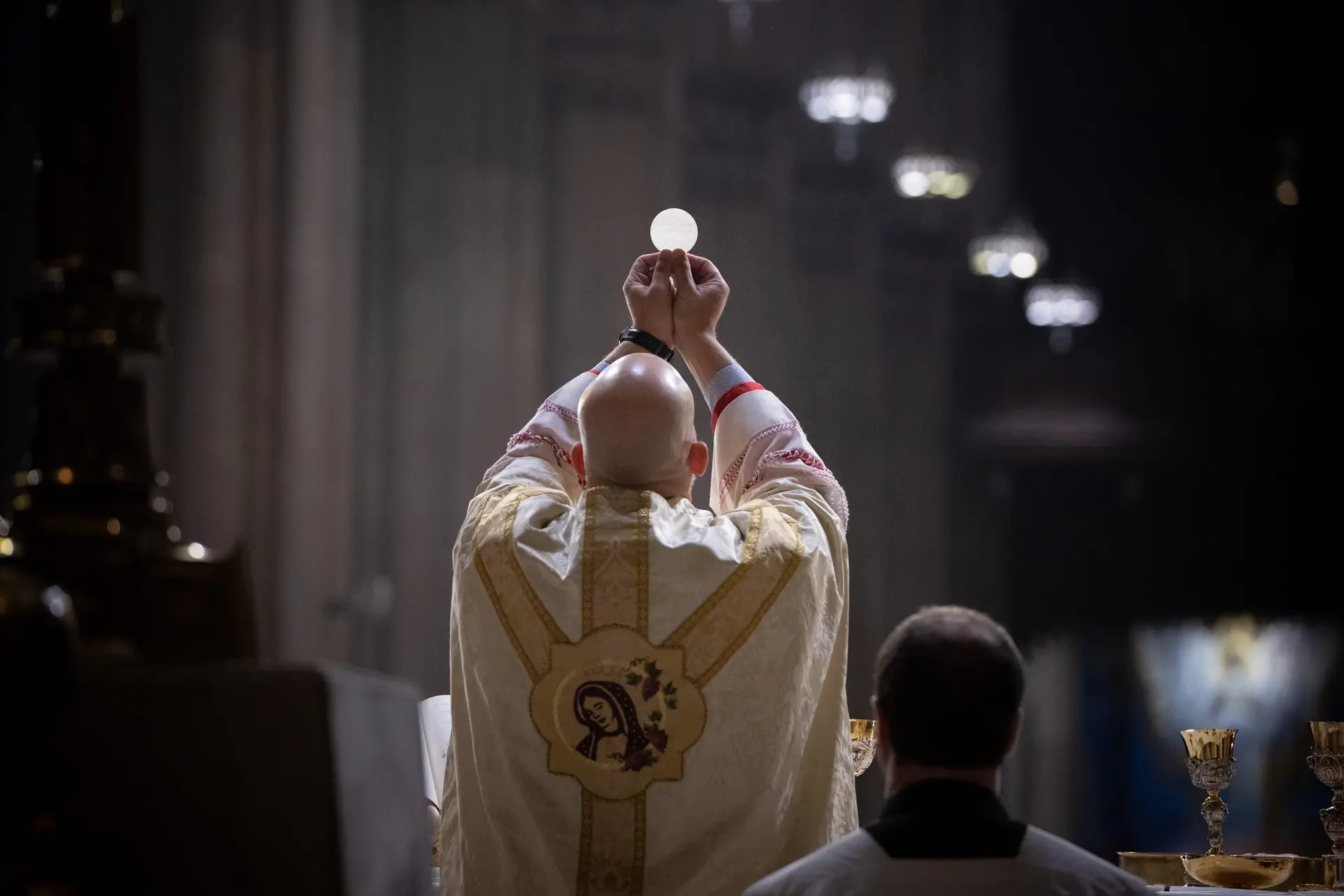
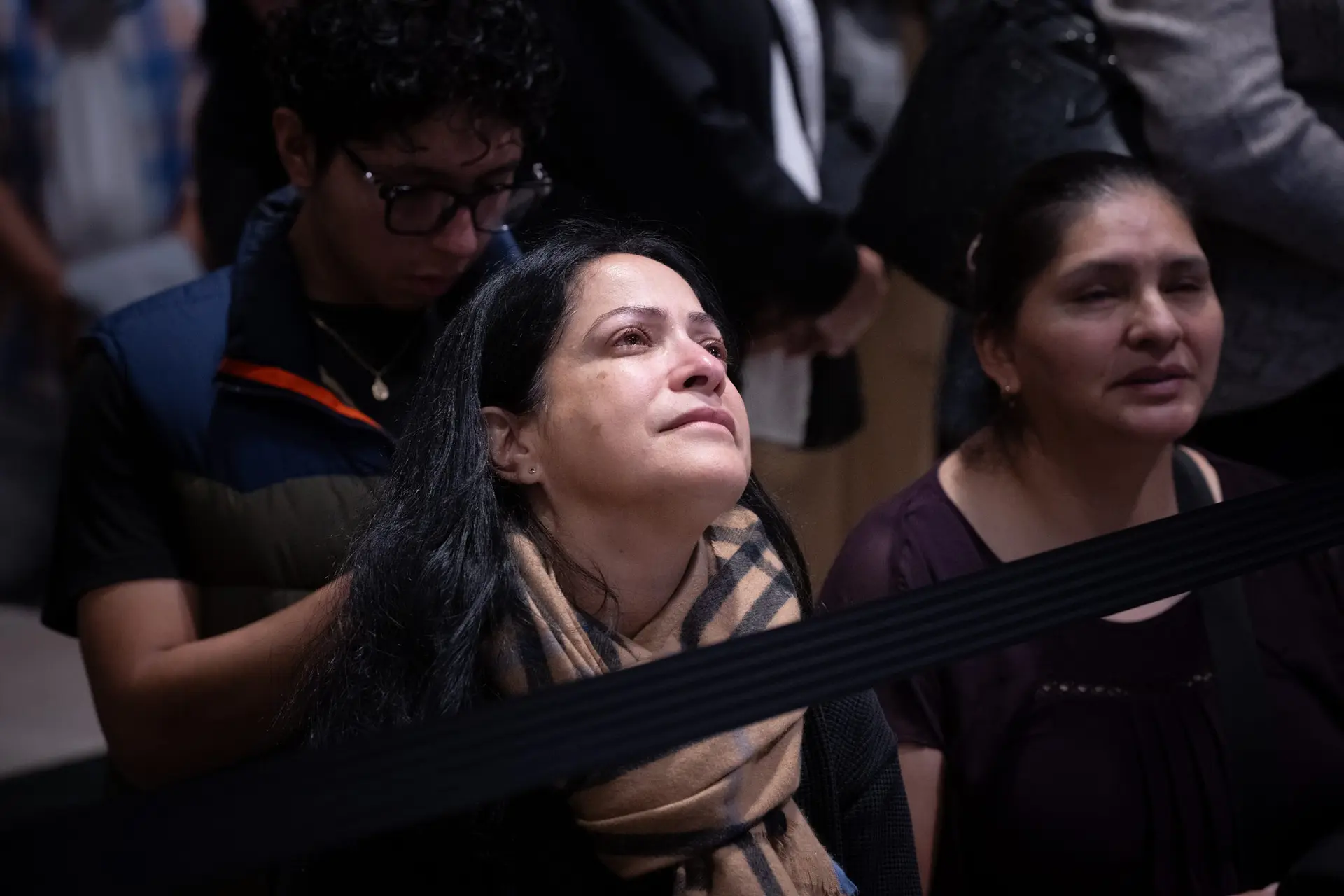
The Blessed Sacrament is raised above the altar. Here is the heart of the afternoon: Christ, who gives Himself to us. | Credit: Jeffrey BrunoIn a crowded cathedral, prayer still has a face. A woman lifts her eyes as heads bow around her. | Credit: Jeffrey Bruno
The cathedral was standing room only. The Sisters of Life, the Franciscan Sisters of the Renewal and Franciscan Friars of the Renewal, the Dominicans, and dozens of other religious filled the cathedral.
And above it all was an absolutely breathtaking sky, with New York's rush hour below.
The afternoon concluded with Benediction, led by Espaillat.
Once dismissed as "Hughes' Folly" for standing too far outside the city, St. Patrick's now stands at its heart.
And the invitation reaches beyond its doors, into the places where we work, the people we pass, and the lives we too easily overlook.
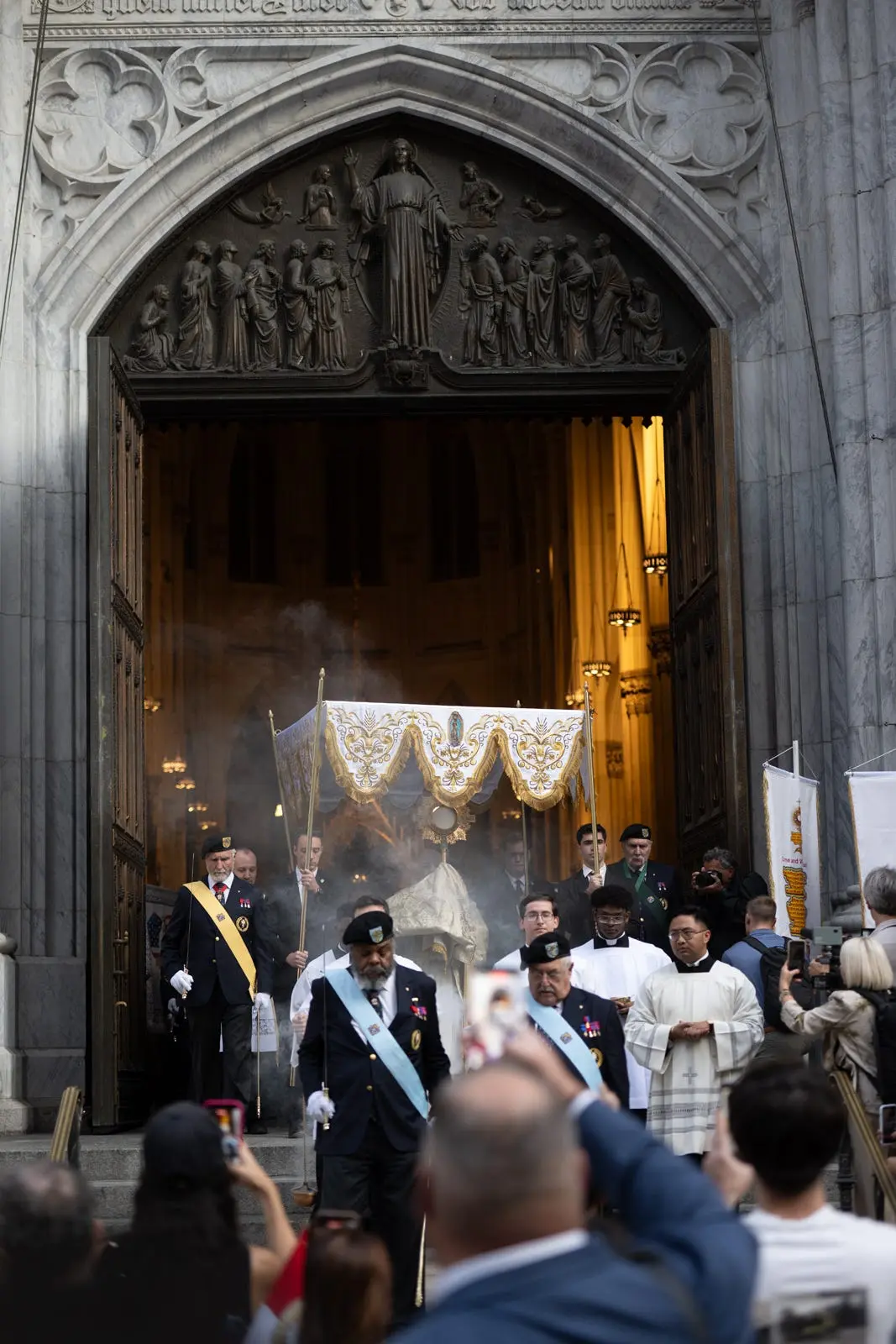
Beneath the figure of Christ above the cathedral doors, the Blessed Sacrament emerges through incense into the afternoon. The invitation is going out into the streets. | Credit: Jeffrey Bruno
In a city that stands as the world's cultural capital, a new culture is emerging: the Culture of Christ.
New generations of Catholics are forming new communities. Churches once quiet are now filled to capacity. And it's no surprise when you realize that by bringing His Presence to the streets, grace overflows.
Christ is here. His love is for every person on these streets.
The culture of Christ begins there.
And, by His Grace, it can begin again in us again.
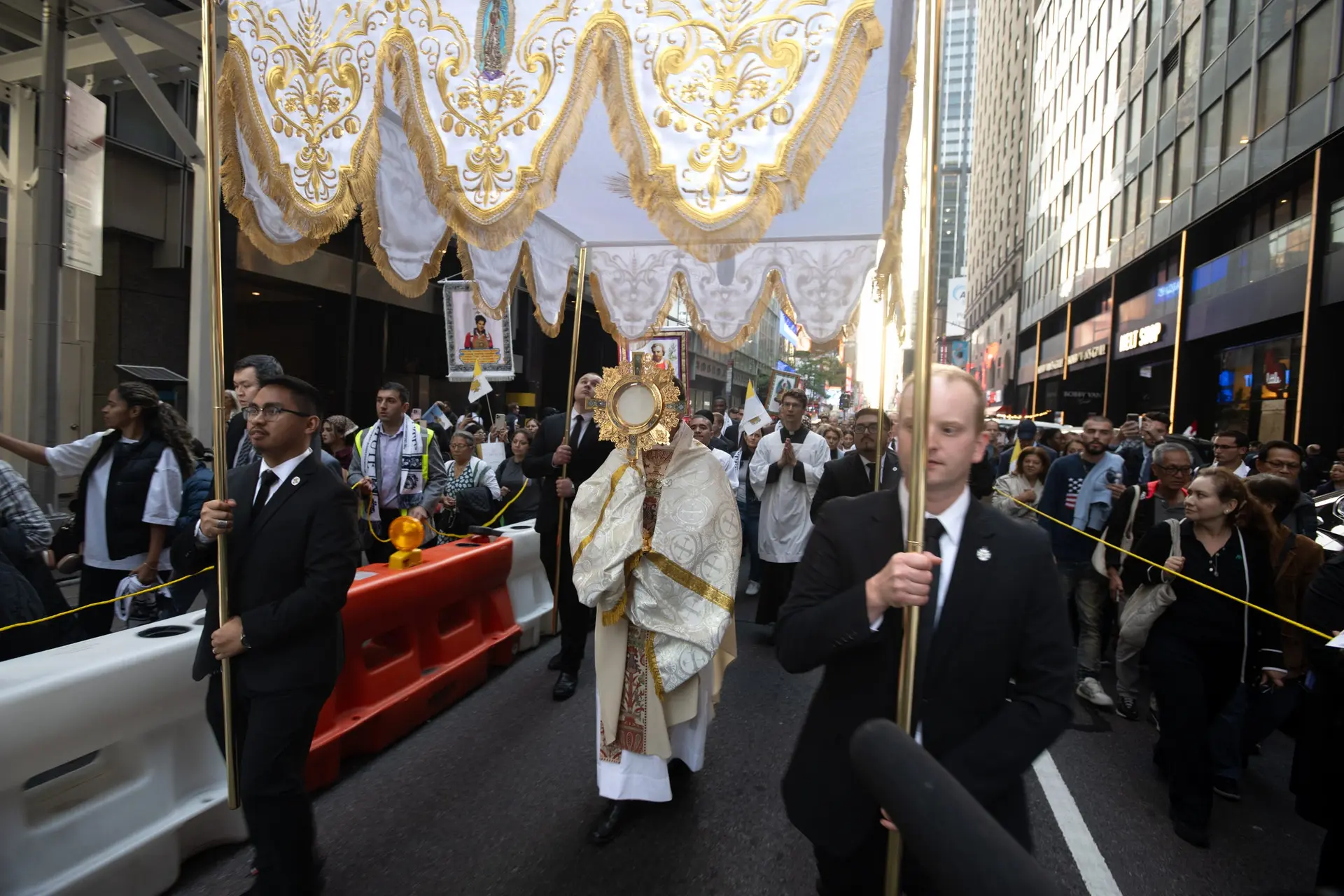
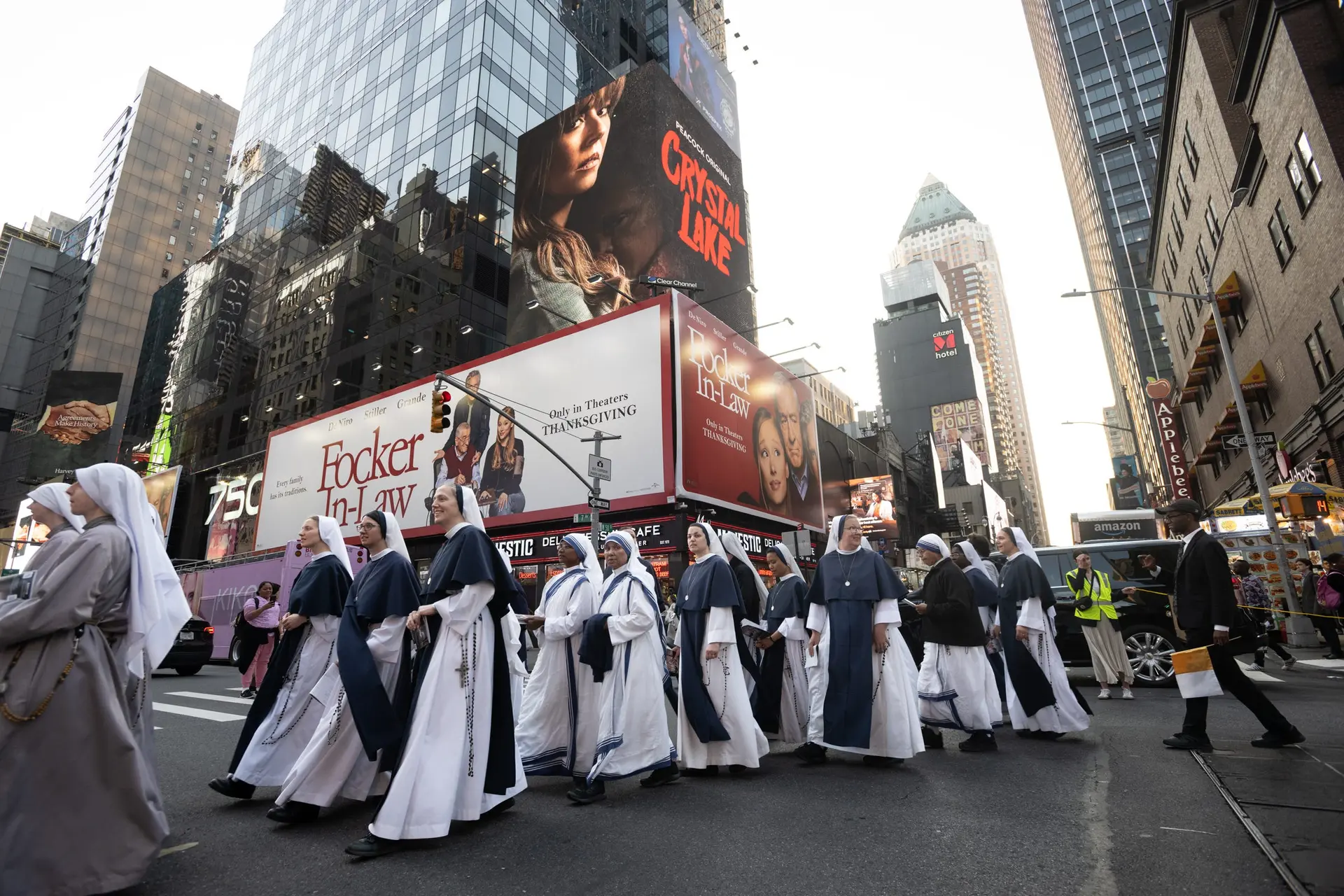
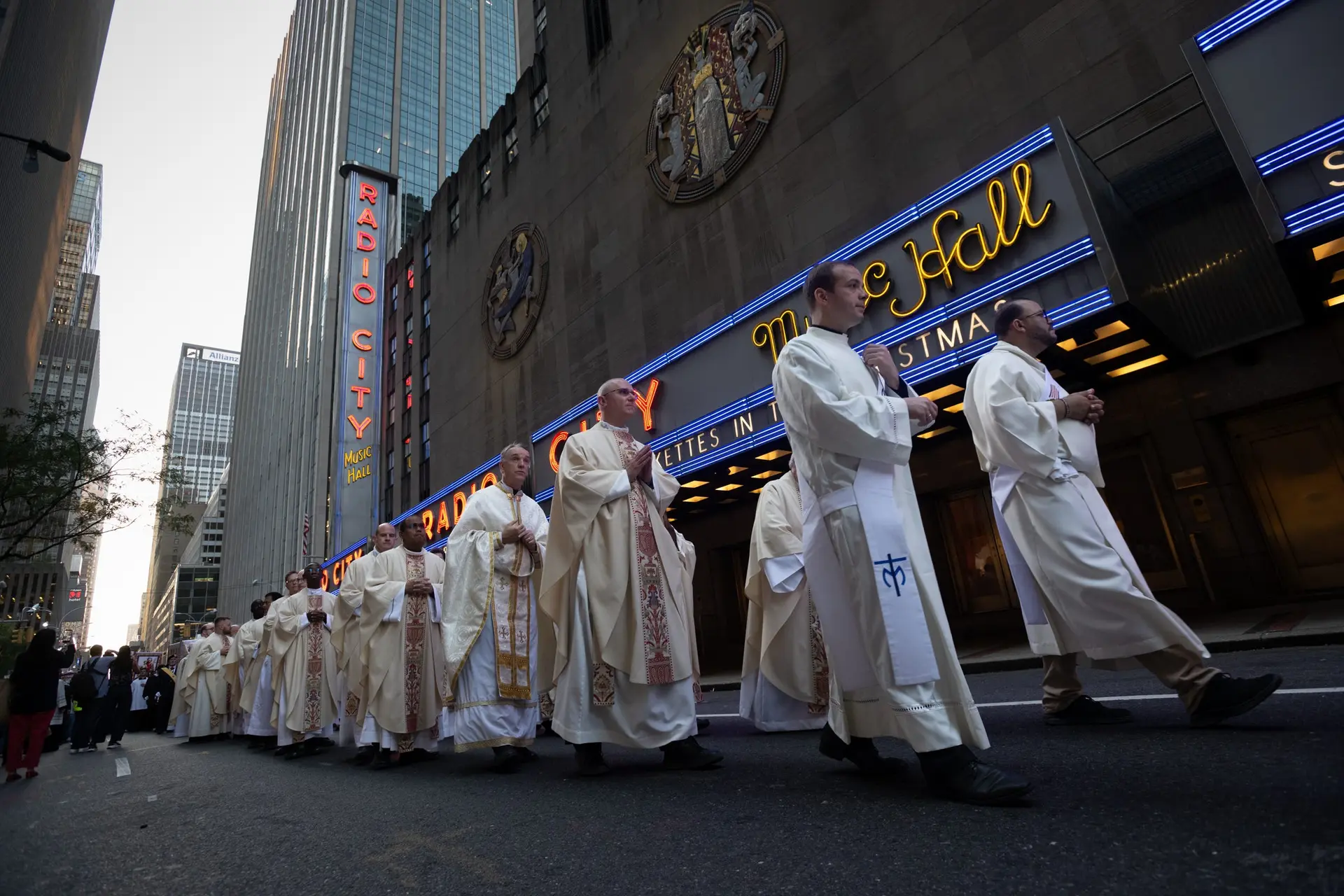
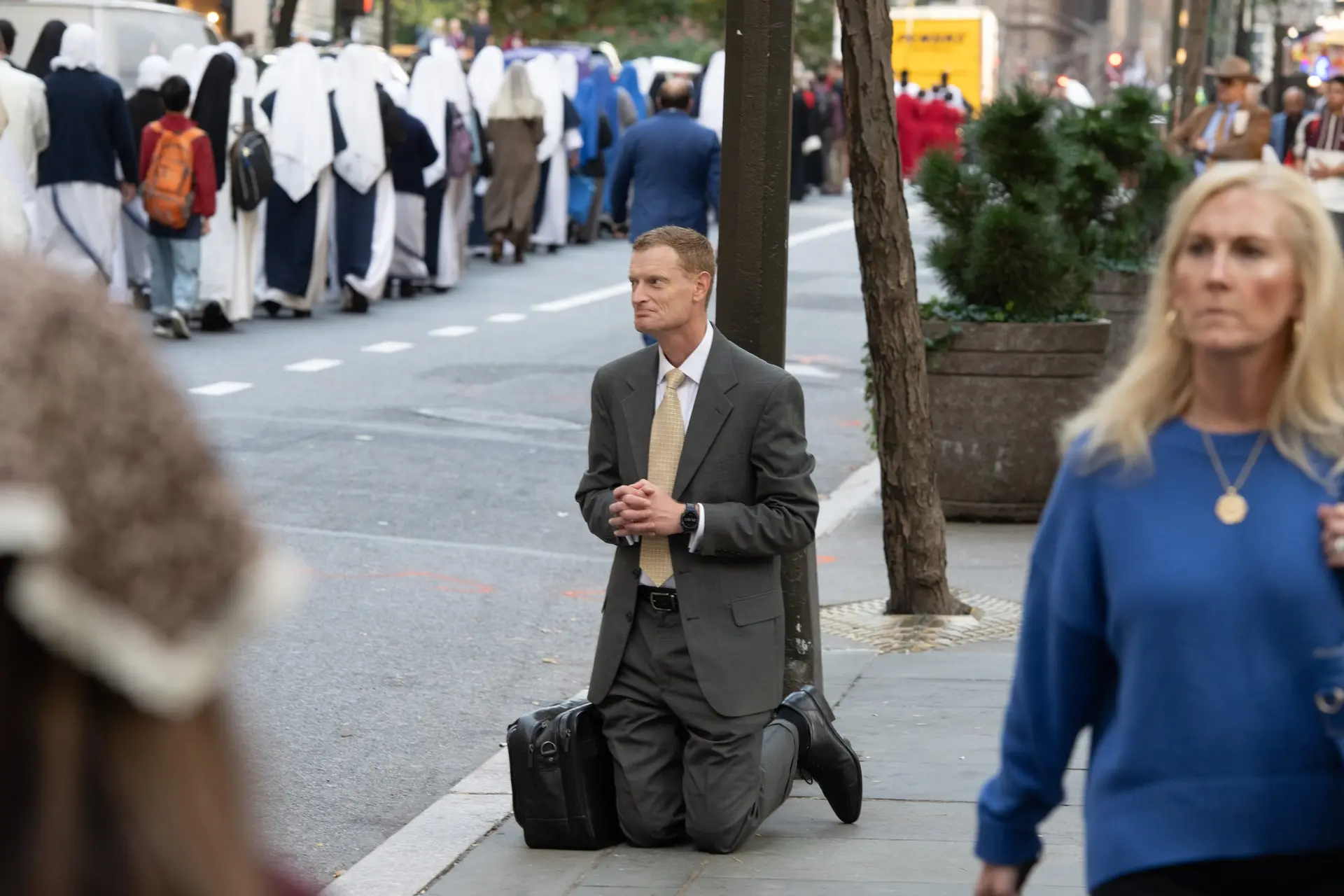
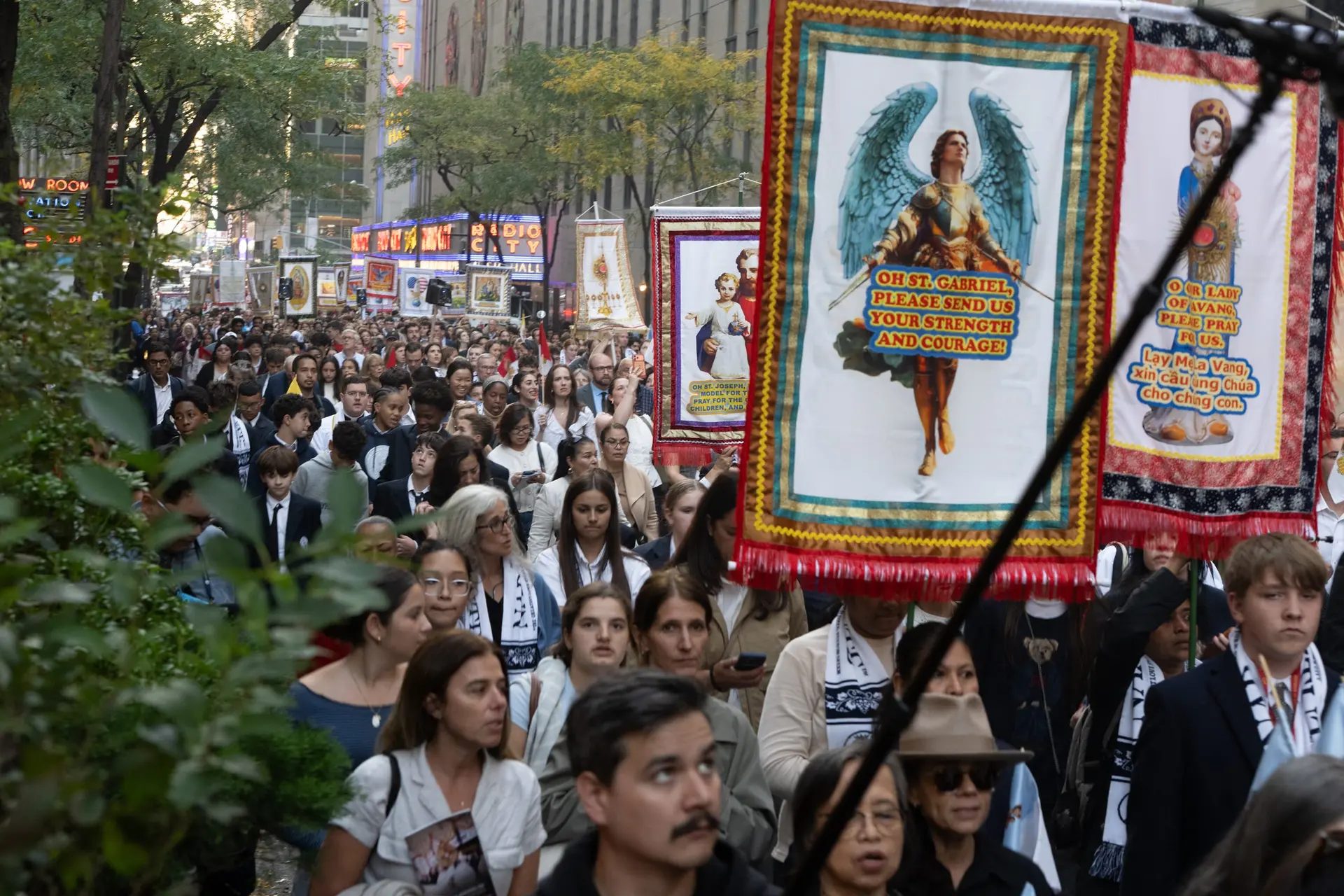
Between construction barriers and office towers, the Blessed Sacrament passes beneath a canopy of white and gold. Christ comes into the city as it is, and into our lives as they are. | Credit: Jeffrey BrunoBeneath Times Square's towering billboards, the Sisters of Life walk with rosaries in hand. Prayer becomes visible at street level. | Credit: Jeffrey BrunoThe line of priests stretches along Radio City Music Hall. | Credit: Jeffrey BrunoA man kneels on the sidewalk beside his bag as the procession passes. An ordinary New York corner becomes a place of adoration. | Credit: Jeffrey BrunoBanners of the saints rise above a crowd stretching down the block. Young and old move forward together, companions on the way to Christ. | Credit: Jeffrey Bruno
This article was first published by the National Catholic Register, EWTN News' sister publication, and has been adapted by EWTN News English.
The massive, five-hour procession in honor of Our Lady of Nazareth begins and ends with a Mass and features pilgrims fulfilling vows for favors granted
The 234th Círio de Nazaré, a traditional pilgrimage honoring Our Lady of Nazareth, drew approximately 2.3 million people to the streets of Belém in Pará state, Brazil, on Sunday, Oct. 11 for a procession that according to organizers is the largest in Brazil and one of the largest in the world.
The procession took about five hours for participants to cover the 3.6-kilometer (about 2.25 miles) route from the Belém Metropolitan Cathedral to Sanctuary Square located in front of the Basilica of Our Lady of Nazareth.
The Círio's Sunday program began at 6:00 a.m. with a Mass celebrated by the Archbishop of Belém, Julio Akamine Endi, in front of the metropolitan cathedral. In his homily, he highlighted the significance of the procession as an expression of a shared journey toward Christ.
"The procession is very slow and takes a long time, but the pace is because we don't want to leave anyone behind; we don't want to abandon anyone along the way. We want everyone to reach Jesus Christ, to reach eternal life together," he said.
"What kind of salvation is it where we leave others behind? We want to walk together, and this must also be reflected in our evangelizing and missionary work," the archbishop continued.
In closing, he invoked the intercession of Our Lady of Nazareth so that the faithful might persevere on this journey: "May Our Lady of Nazareth, in whose honor we hold this most beautiful procession, help us to walk together toward the definitive Kingdom."
Akamine also urged the faithful to care for others and to look after the salvation of their brothers and sisters, following Mary's example.
"Let us ask Our Lady of Nazareth that we may know how to be submissive to God, just as she was, and that we may also care more, having zeal for the salvation of our brothers and sisters. We do not achieve this by seeking to claim a leading role that is not ours. The leading role always belongs to God. He is the Savior. He is the Savior of all. He is our Savior. And it is by obeying God that we actively collaborate in the salvation of humanity," he noted.
Devotees fulfilling vows express their faith on the streets of Belém
After Mass, the image of Our Lady of Nazareth was placed on the "berlinda" (a ceremonial carriage) and taken in procession through the streets of Belém, pulled by a rope, one of the symbols of the Círio festival, that devotees strive to hold onto.
Along the route, devotees fulfilled their vows in various ways: walking on their knees, carrying heavy crosses or images of Our Lady, performing ballet, and even while blindfolded.
Among those fulfilling vows was 28-year-old Fabrício Corrêa, who traversed the route on his knees to honor a promise made for his mother's recovery. She was facing complications resulting from diabetes and was at risk of having one of her feet amputated.
"I am an Evangelical and asked God to heal her, but I also went to the basilica and asked Our Lady to intercede with Jesus so that he would grant this healing to my mother," Corrêa told the website O Liberal.
According to him, a week later, the family received the news that the amputation would not be necessary. His mother lost only one of her toes, and Fabrício fulfilled the vow during this year's Círio.
"I promised that if she interceded, I would fulfill that vow. I kept that to myself," he said. His mother, a Catholic, did not know her son had made the vow and only learned of his participation in the Círio after the video went viral on social media.
Along the route, individuals and institutions also paid tribute to Our Lady of Nazareth. To help alleviate the heat, the fire department used water trucks, while volunteers distributed water to the pilgrims.
After the image arrived at Sanctuary Square, the program for the procession concluded with a Mass celebrated by the auxiliary bishop of Belém, Paulo Andreolli.
The Círio schedule of events continues throughout October with other pilgrimages and religious activities, leading up to the "Recírio", which marks the conclusion of the festivities in honor of Our Lady of Nazareth.
This story was first published by ACI Digital, the Portuguese-language sister service of EWTN News. It has been translated and adapted by EWTN News English.
The document "A Call for Christian Compassion and Wisdom in the Immigration Debate" is the product of the Evangelical-Catholic Dialogue on Immigration.
The U.S. Conference of Catholic Bishops (USCCB) and the National Association of Evangelicals (NAE) have teamed up in calling for "compassion" in immigration policy amid U.S. President Donald Trump's ongoing crackdown.
Bishop Brendan Cahill, who chairs the USCCB Committee on Migration, signed onto the five-page document along with NAE President Walter Kim, as part of a joint effort called the Evangelical-Catholic Dialogue on Immigration (ECDI).
"As Catholic and evangelical Christians, we have doctrinal differences, but we are united in our conviction that God calls us to stand both with our fellow Americans who are experiencing economic and cultural anxieties and with our immigrant neighbors who are facing existential challenges," they indicated.
According to a USCCB news release, ECDI timed the statement to correspond with an increase in reported detentions and deportations, as well as the ending of Temporary Protected Status (TPS) for nationals of several countries, including Haitians and Syrians.
The document puts a "special focus" on children and families, citing Matt. 18:5, in which Christ says, "whoever receives one child such as this in my name receives me."
Cahill and Kim emphasized all people, regardless of where they are born or their immigration status, are made in the image of God, adding: "This dignity comes from God, not government, and no earthly power may erase it."
"The stranger is not merely a burden to bear," they wrote. "Again and again, God has blessed his people through the outsider. From Ruth the Moabite to the present day, immigrants can bring renewal to congregations and communities that welcome them. We lament approaches that pit citizens against noncitizens."
Both leaders said that they recognize the government's responsibility to secure and manage borders, but that governments must also uphold religious liberty, protect the persecuted, and facilitate pathways for legal immigration.
Cahill and Kim encouraged "a better path forward," which they argued would be consistent with all of those obligations.
"Catholic and evangelical Christians make up a large portion of our American citizenry," the letter added. "Majorities of evangelicals and Catholics support immigration reform that would provide meaningful opportunities for longtime residents to regularize their status."
According to the document, one element is secure borders and targeted immigration enforcement that protects family unity and prioritizes action against people who are a threat to public safety.
Other elements include limiting detentions of non-violent people, access to chaplains, and more legal pathways to permanent status for workers, family members, and humanitarian populations.
Cahill and Kim asked Christians to pray for their leaders as commanded in 1 Tim. 2:1-2, which reads: "First of all, then, I ask that supplications, prayers, petitions, and thanksgivings be offered for everyone, for kings and for all in authority, that we may lead a quiet and tranquil life in all devotion and dignity."
"Our promise of prayer extends to our law enforcement officers, our policymakers, our judges, and all in our communities who play an essential role in building up the common good," they wrote.
"Every Christian deserves to know that he or she has been made a new creation in Christ and is a member of his Body — no matter what the particular circumstances of duty or residence," the document points out.
"I ask you please to pray for me, as I pray for you," Pope Leo XIV wrote.
Pope Leo XIV, recovering from lung cancer surgery in Rome, sent a request for prayers to participants in a Vatican conference.
"As you know, I have been unable to be among you during these days," Pope Leo wrote in the Oct. 14 message to clergy members and Catholics. "I thank you warmly for your prayers and for the work you have done together. Your sharing of experiences and attentive listening are indeed a gift to the whole Church."
The pope's message was read at the conclusion of the conference "10 Years After Amoris Laetitia: Proclaiming the Gospel with Families Today," a meeting examining the legacy of the apostolic exhortation and how to strengthen family participation in the church's mission.
"Entrusting each of you to the protection of the Holy Family of Nazareth, I ask you please to pray for me, as I pray for you," he wrote.
The pope encouraged participants to bring the meeting's insights back to their bishops' conferences and dioceses, continue proclaiming the Gospel with families, and ensure families remain active participants in the life and mission of local churches.
Leo's homily delivered
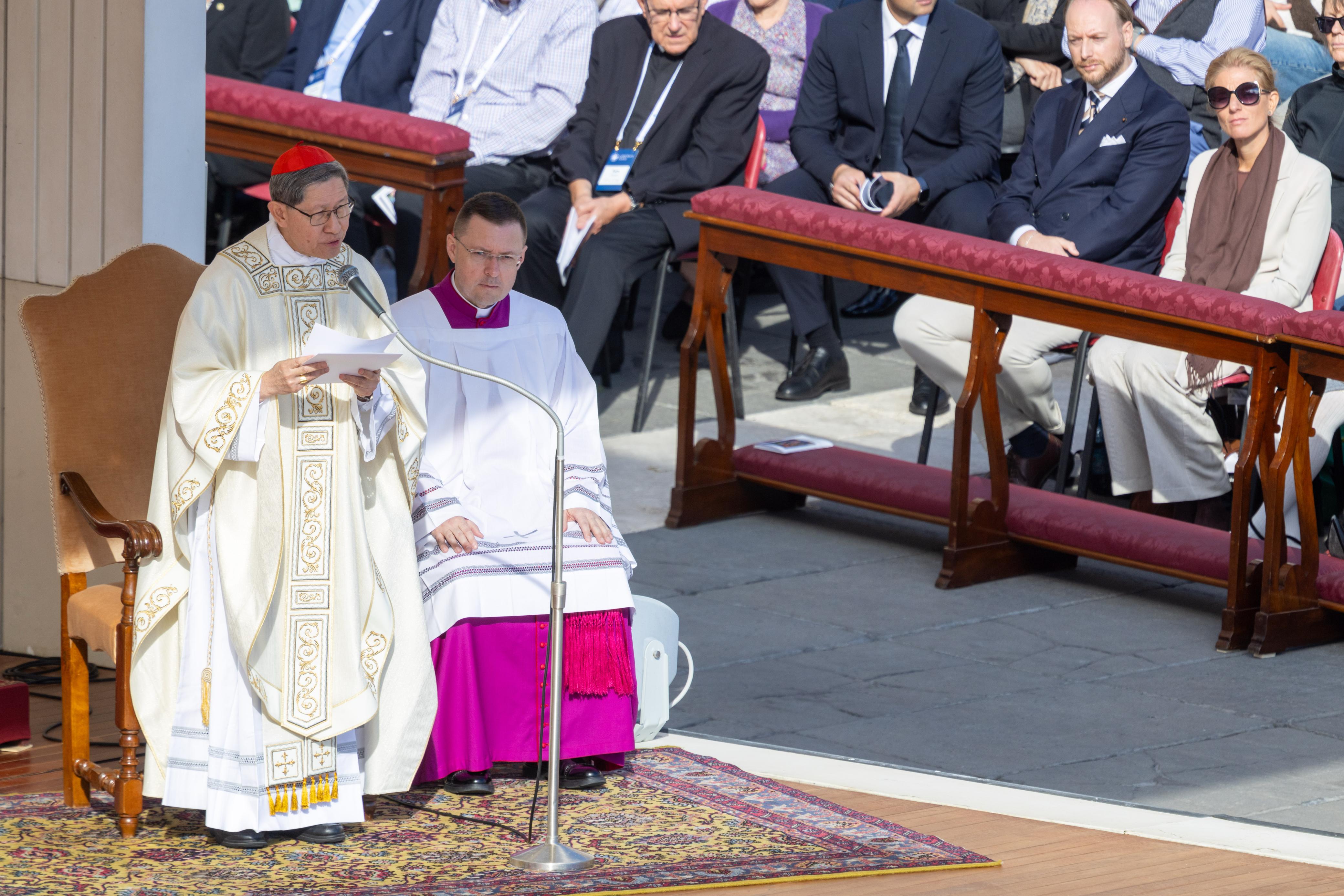
At the closing Mass for the conference "10 Years After Amoris Laetitia: Proclaiming the Gospel with Families Today," Cardinal Luis Antonio Tagle, dean of the College of Cardinals, delivered a homily prepared by Pope Leo XIV, saying, "the world has no future without strong families open to the gift of children and attentive to their education and growth."
Families and faith communities should accompany people facing hardship with compassion rather than condemnation, the pope's homily said.
Cardinal Luis Antonio Tagle celebrates Mass in St. Peter's Square on Oct. 14, 2026, in place of Pope Leo XIV for the closing of a meeting marking 10 years of Amoris Laetitia. | Credit: Daniel Ibáñez/EWTN News
"Those who are more vulnerable, or who are experiencing difficult circumstances and moments of crisis, will also find support and encouragement, surrounded by affection and shielded from judgment and prejudice. Let us remember that 'as wounded as the family may be, it can always grow beginning with love,'" Tagle said, delivering the homily prepared by Pope Leo.
Doctors say the pontiff's recovery is proceeding as expected, while the Vatican confirms his desire to go ahead with a planned visit to Latin America in November.
ROME — Pope Leo XIV is recovering well after undergoing surgery Tuesday to remove the lower lobe of his right lung, which was affected by pulmonary adenocarcinoma, the most common type of lung cancer.
The medical report released by the Vatican was signed by his personal physician, Dr. Luigi Carbone, and Dr. Stefano Margaritora, the surgeon who led the operation.
The bulletin said the Holy Father underwent scheduled "blood tests and a chest X-ray" Wednesday morning.
"The results confirm a normal postoperative course: The values are within the expected range for the type of surgery performed," the doctors said.
The bulletin also highlighted progress in his physical recovery.
"The Holy Father underwent respiratory physiotherapy and began walking around his room," the doctors reported, referring to an activity considered essential to recovery after lung surgery.
The physicians also said the pontiff had resumed his normal diet.
"Recovery is proceeding as expected," they said in the bulletin released by the Holy See, easing concerns that arose late Tuesday when the Vatican confirmed the cancer diagnosis.
A histological examination confirmed that the pope had pulmonary adenocarcinoma.
The first encouraging news came early Wednesday morning, following an anxious night. In a brief statement, the Vatican confirmed that the pope had spent a "peaceful night" and was continuing to recover from anesthesia in his room on the 10th floor of Rome's Gemelli Hospital.
A few hours later came confirmation that, despite his hospitalization, Leo remains able to carry out his responsibilities governing the Church.
At noon, the Holy See announced that the pontiff had accepted the resignation of Archbishop Bernard Bober from the pastoral governance of the Archdiocese of Košice, Slovakia, and appointed Auxiliary Bishop Marek Forgác of the same archdiocese as his successor.
He also appointed Bishop Wellington de Queiroz Vieira as the new metropolitan archbishop of Cuiabá, Brazil, transferring him from the Diocese of Cristalândia.
The pope's clinical progress will determine the course of his treatment over the coming weeks. Doctors continue to monitor his postoperative recovery closely before making decisions about the next stages of treatment and his schedule in the coming days.
For now, all his scheduled engagements remain canceled through next Tuesday.
Among the upcoming events awaiting confirmation is the Angelus on Sunday, Oct. 18. If his medical condition permits, the pope could lead the prayer from the hospital, a gesture that would be seen as an encouraging sign of his recovery.
Members of the pope's closest entourage, known in Vatican terminology as the papal household, remain at his side. They include his two personal secretaries, Peruvian Father Edgard Iván Rimaycuna Inga and Italian Father Marco Billeri.
A blessing from heaven
Meanwhile, Gemelli Hospital continues to receive expressions of affection and solidarity from faithful who have come from around the world.
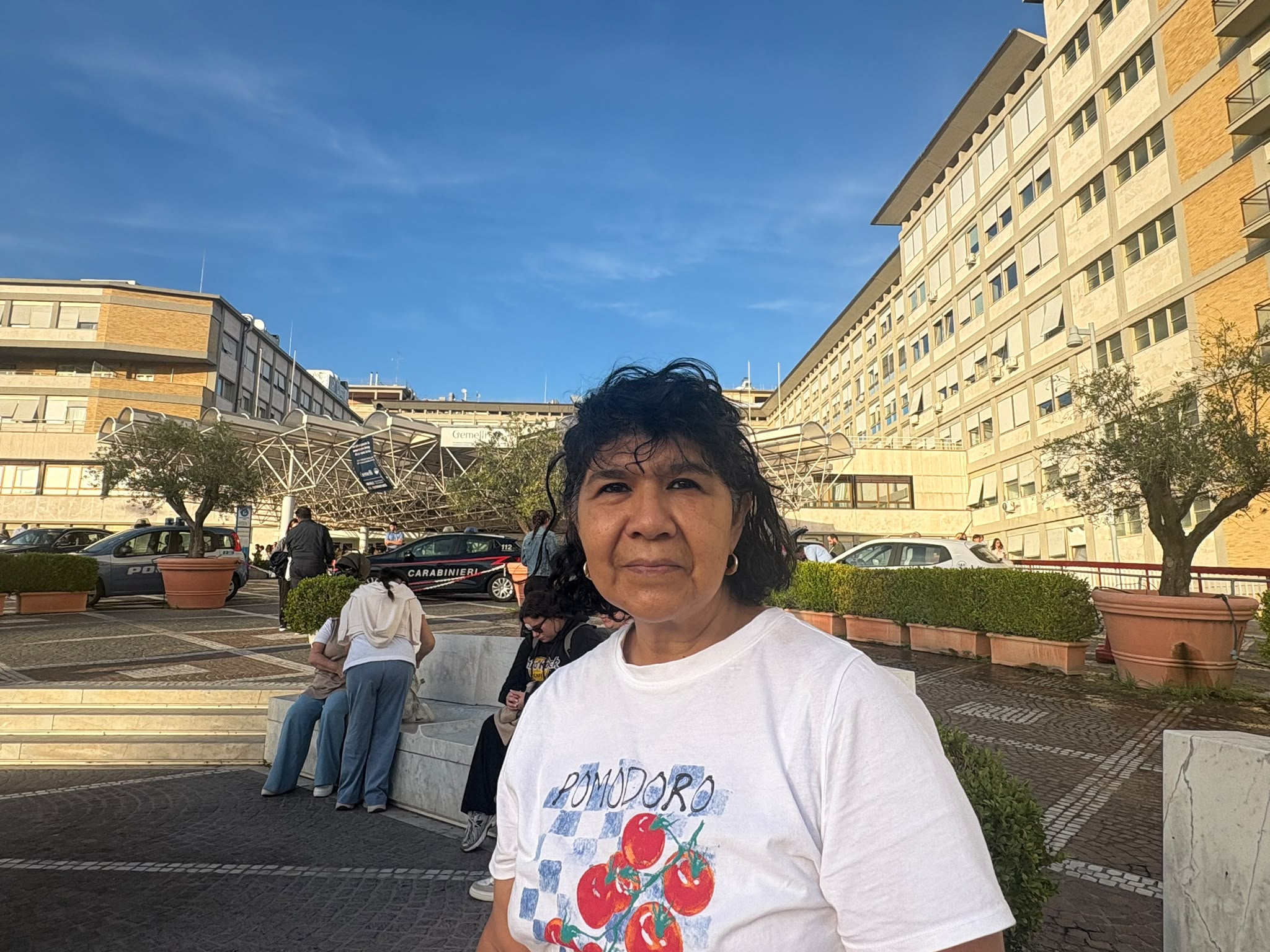
Among them is Gina, a native of Lima, Peru, who was praying before the imposing statue of St. John Paul II in the courtyard of the Rome hospital.
For the past two years, she has cared for her husband, who has Parkinson's disease. He is currently hospitalized at Gemelli after developing an infection.
For Gina, being in the same hospital as the pope is more than a coincidence. She considers it a "blessing from heaven" that helps her endure her suffering.
Gina, a Peruvian woman whose husband is also hospitalized at Gemelli Hospital, says: "Knowing that the pope is here helps me keep going." | Credit: Victoria Cardiel/EWTN News.
"It gives me strength to think that my husband is suffering as a patient just a few yards from the Holy Father. I know his suffering is not in vain because we offer it to God," she told EWTN News.
For Gina, the circumstances have strengthened her faith and hope.
"That has given me more strength and more hope. Knowing that the pope is here helps me keep going," she said.
She happened to return from Peru, where she had traveled to visit family, on Oct. 11, after leaving Rome on Aug. 28. Her return coincided with the news of the pontiff's impending surgery.
"My mother called me the next day and asked how my husband was doing. When I told her that the pope was in the same hospital, she burst into tears: 'Blessed be God, blessed be God,'" Gina recalled.
She also described the excitement building in Peru ahead of Leo's planned visit.
"Choirs, folk groups, and many local residents are organizing to celebrate his arrival. He's going to see the children he baptized, the children who have grown up and are now adults. People adore him," she said.
Gina said she cannot imagine the pontiff having to cancel his planned trip to Latin America.
For now, however, the messages coming from the Vatican have been encouraging.
Holy See Press Office director Matteo Bruni emphasized that the tumor was "at an early stage" and that the nodule removed was "circumscribed and localized."
The statement released after the operation used the term "radicality" to indicate that doctors believe the lesion was completely removed.
Specialists also believe that the loss of a lung lobe should not have significant consequences for the daily life of a patient in Leo's physical condition.
Speaking to reporters Wednesday, Oct. 14, Bruni referred to the pope's "desire" to proceed with his trip scheduled for early November.
"We have heard the pope's words about the trip, and therefore his intention, his desire, and also the fact that ... he wants to go," the Vatican spokesman said.
This story was first published by EWTN News Español, the Spanish-language sister service of EWTN News. It has been translated and adapted by EWTN News English.
The Holy See Press Office confirmed the nodule removed on Tuesday during Pope Leo's surgery is a type of non-small cell lung cancer. Follow here for more updates.
The Holy See Press Office confirmed the nodule removed on Tuesday during Pope Leo's surgery is a type of non-small cell lung cancer. Follow here for more updates.
According to lung cancer expert Luis Ráez, Pope Leo's treatment will depend on the size of the tumor and whether the cancer has spread.
After a surgery on Tuesday in which the lower lobe of his right lung was removed, Pope Leo XIV was diagnosed with lung cancer. Dr. Luis Ráez, a prominent oncologist, explained in an interview with EWTN News what pulmonary adenocarcinoma is and what factors will determine the Holy Father's next medical steps.
Ráez, who is not treating the pope, serves as the medical director and head of the Thoracic Oncology Program at the Memorial Cancer Institute in Florida.
The Vatican reported that the pope had "the lower lobe of the right lung removed using a video-assisted technique. The intraoperative histological examination has confirmed the diagnosis of pulmonary adenocarcinoma, as was suspected from the preoperative tests."
The most common lung tumor
"The Holy Father remained in the operating room for approximately 3 hours; the duration of the surgery was approximately 90 minutes. The surgery was a success and there were no complications," the Holy See added.
Ráez explained that adenocarcinoma "is the most common tumor in the lung" and noted that "in general, lung cancers are more aggressive than those of the prostate or breast."
However, he clarified that seriousness is not defined solely by the type of cancer, but that "the prognosis depends on the stage, that is, the size of the tumor and how far it has spread."
'Stage one or stage two'
The pope said during the Angelus prayer on Sunday, Oct. 11, that a nodule on his lung was detected "at a very early stage" and was "well localized." Ráez speculated that the decision to operate could confirm that the cancer is not at an advanced stage.
"We assume that is the case because they subjected him to surgery. If it were metastatic, for example, stage three or stage four, which are advanced, most likely they would not have operated on him. An operation usually implies stage one or stage two," he said.
Asked what will determine whether removal of part of the lung is sufficient or whether additional treatment will be required, Ráez highlighted the importance of the tumor size and the absence of metastases.
"If the tumor is larger than four centimeters, the surgery will not be enough and chemotherapy will be necessary. If the tumor is smaller than four centimeters, the surgery is sufficient and nothing else is done. A patient then moves to an observation phase with check-ups every six months," he explained.
The recovery process
Regarding the chances of a cure, Ráez noted that, under optimal conditions and with a tumor smaller than four centimeters, the figures are favorable: "The chance of cure for early-stage lung cancer is 80 to 90%; it is not total because the cancer can come back."
Regarding the physical recovery of Pope Leo XIV, who is 71 years old, Ráez expressed a favorable short-term prognosis. "Since he is a healthy man, the most likely thing is that he will be fine" in a few weeks, he stated.
He added that this surgery usually requires a hospital stay of two or three days in the United States and considered that, in the pontiff's case, more days of hospitalization may have been planned as a precaution.
Regarding medical follow-up after discharge, the specialist stressed that the protocol does not end when one leaves the hospital. "For the next five years, control CT scans must be done every six months, until one is sure that the cancer has not returned and that he has been cured," said Ráez, who has more than two decades of experience in hematology and medical oncology.
This story was first published by EWTN News Español, the Spanish-language sister service of EWTN News. It has been translated and adapted by EWTN News English.