During his apostolic journey to Spain from June 6–12, Pope Leo XIV became the first pontiff in history to address the Spanish Parliament, using the occasion to urge the country's political class to defend human dignity and protect life "from conception to its natural end."
The pontiff also joined the list of other pontiffs since St. Paul VI who have been invited to speak to government assemblies during their journeys.
While it is expected that the pope will address civil leaders during an apostolic journey, invitations to address a country's legislature or national assembly are rare and considered a high honor, even for a pope. These addresses have often been opportunities for the pope to challenge civil leaders on critical issues, including human rights, war, and the treatment of migrants.
But what do these speeches reveal about the pope's priorities regarding global issues?
St. Paul VI: A call for an end to war
As the first pope in centuries to undertake extensive international travel, Paul VI was known for his forceful calls to denounce war and promote peace.
He became the first pontiff to address the United Nations (U.N.) General Assembly during his historic one-day visit to the United States on Oct. 4, 1965. He addressed the assembly in the wake of the Cuban Missile Crisis, the Vietnam War, and the Indo-Pakistani War, which had occurred mere weeks before his visit.
Amid these and other conflicts, Paul VI made a passionate appeal for peace, famously declaring: "Never again war, never again war! It is peace, peace, that has to guide the destiny of the nations of all mankind!"
With this speech and similar ones, including a little-known one delivered to the Ugandan Parliament in 1969, the pope would forever alter the Holy See's role in international affairs, establishing it as an important actor in international diplomacy. He also helped establish the Church's anti-war stance early in the modern period, a stance adopted by every pope since.
St. John Paul II: Papal presence in the public sphere
Whereas Paul VI would pioneer the pope's presence in the public sphere, St. John Paul II would make it the norm.
The Polish pontiff delivered at least five addresses to secular parliaments, including those of the European Union, Poland, and Italy.
He also addressed the U.N. General Assembly twice during his papacy. The first, in 1979, challenged the U.N. to denounce the arms trade, ensure religious freedom, and protect religious minorities in the Middle East.
Though noted for his stance on life issues, including opposition to abortion, he did not address abortion in any of his addresses to parliaments, instead focusing more broadly on human rights.
Benedict XVI: Religion cannot be set aside in the West
Pope Benedict XVI became the first pontiff to address both houses of the British Parliament during his visit to the United Kingdom in September 2010.
Referring to St. Thomas More and the country's Christian heritage, Benedict denounced the tendency toward the marginalization of religion in the West, particularly Catholicism.
"I cannot but voice my concern at the increasing marginalization of religion, particularly of Christianity, that is taking place in some quarters, even in nations which place a great emphasis on tolerance," Benedict said. "These are worrying signs of a failure to appreciate not only the rights of believers to freedom of conscience and freedom of religion, but also the legitimate role of religion in the public square."
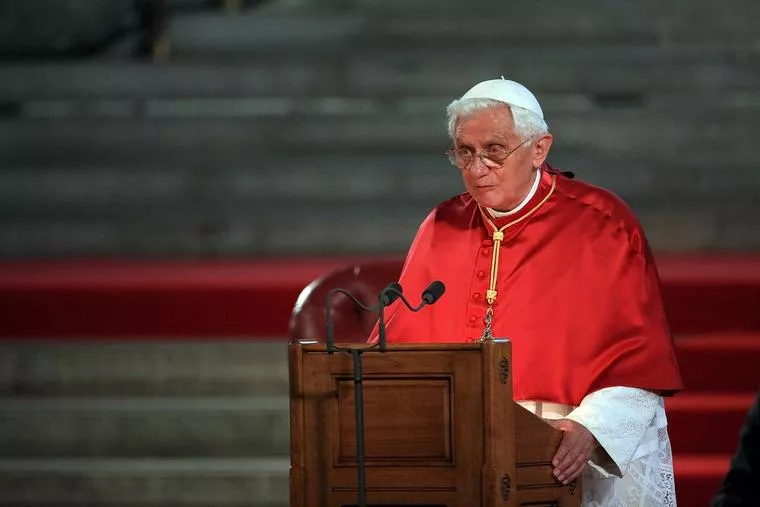
Such sentiments would be reflected in his address to the Federal Parliament of Germany during his 2011 visit. Already famous for his advocacy of the relationship between faith and reason, Benedict gave a speech highlighting the role of natural law and the limits of democracy.
"For most of the matters that need to be regulated by law, the support of the majority can serve as a sufficient criterion. Yet it is evident that for the fundamental issues of law, in which the dignity of man and of humanity is at stake, the majority principle is not enough."
Francis: Environmental justice, migrant care, and the abolition of the death penalty
When Pope Francis became the first pope to address a joint session of the United States Congress in 2015 during his visit to the country, he offered a candid assessment of issues in the national debate, especially immigration.
Referring to the 2015 refugee crisis, in which Syrians fled the civil war in Syria for the U.S., Francis advocated greater care for those coming to the U.S. to find a better life.
"Our world is facing a refugee crisis of a magnitude not seen since the Second World War. This presents us with great challenges and many hard decisions," Francis said. "We must not be taken aback by their numbers, but rather view them as persons, seeing their faces and listening to their stories, trying to respond as best we can to their situation."
He would also, like several of his predecessors, oppose the death penalty. Unlike them, however, he would call for its abolition, support the U.S. Conference of Catholic Bishops' initiative for abolition that year, and criticize the resumption of executions by lethal injection.
"This conviction has led me, from the beginning of my ministry, to advocate at different levels for the global abolition of the death penalty. I am convinced that this way is the best, since every life is sacred, every human person is endowed with an inalienable dignity, and society can only benefit from the rehabilitation of those convicted of crimes."
He would use these ideas presented to Congress to finally amend the Catechism of the Catholic Church in 2018, declaring that the death penalty is "inadmissible."